Professional Chefs Reveal Their Most Essential Kitchen Pans
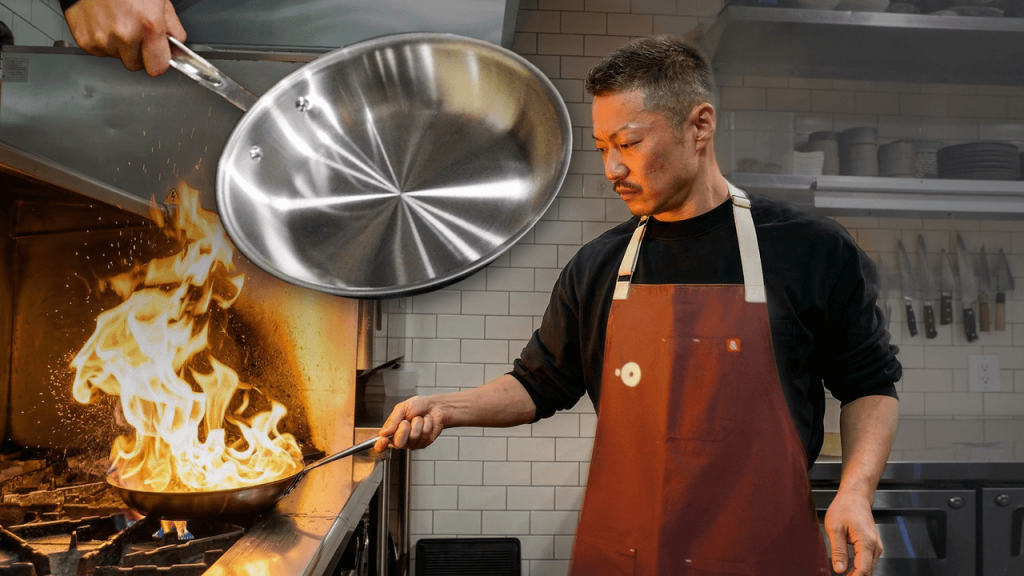
While professional chefs may treasure their personal knife collections, the pans they rely on daily in restaurant kitchens tell a different story. These workhorses are typically practical, affordable pieces—whatever equipment happens to be available on the kitchen shelf. However, this doesn’t mean culinary professionals lack strong preferences about their cookware choices.
The encouraging news for home cooks is that restaurant-quality equipment is often both budget-friendly and readily accessible. We spoke with ten chefs from acclaimed restaurants and bakeries to discover which pans they depend on most during service, and their diverse answers reflect the varied needs of different culinary establishments.
The Five-Quart Saucier
Direct-to-consumer cookware brands rarely earn recognition in professional kitchens, but Made In has successfully penetrated the restaurant scene. Jackie Carnesi from Kellog’s Diner praises her substantial Made In saucier, which she acquired several years ago. She explains its versatility: “It excels at preparations requiring whisking, like caramel, or dishes needing a rubber spatula. The design also makes it excellent for tossing ingredients, and its relatively light weight facilitates easy flipping.”
Japanese Carbon Steel Craftsmanship
Carbon steel pans are restaurant kitchen staples, though hand-hammered Japanese versions are less common. Fredrik Berselius, executive chef at Michelin-starred Aska, favors Kama-Asa carbon steel skillets despite their weight. “The extended handles provide excellent balance,” he notes, making them manageable during intense service periods.
The Utilitarian Hotel Pan
Those unfamiliar with commercial kitchens might not recognize hotel pans—the deep trays commonly used for large-scale steaming operations. Chef Mary Attea from the Musket Room appreciates their surprising durability despite minimal weight. She employs them for initiating large rice batches on stovetops and creating quick smoking effects when combined with heavy-duty foil.
Cast Iron Versatility
Le Creuset’s appearance on any chef’s favorites list should surprise no one. Neal Kajalle from Adda utilizes a compact braiser for both cooking and serving. “Cast iron delivers excellent searing capabilities and maintains temperature exceptionally well—it simply performs,” he states. Kajalle also employs Le Creuset’s magnetic trivets, which attach to pan bottoms to protect tables when serving directly from hot ovens.
Specialized Vietnamese Equipment
Without extensive Vietnamese culinary knowledge, most cooks wouldn’t recognize Nhu Tahn’s preferred tool: a lightweight aluminum báhn xèo wok designed specifically for ultra-thin Vietnamese pancakes. This pan accompanied Tahn to America and now serves as the cornerstone at Bahn Ahn Em. “Its lightness allows easy batter manipulation and heat adjustment—something impossible with cast iron or carbon steel,” she explains.
Traditional Cast Iron Reliability
Chef Maria Barriga from Oxomoco champions cast iron for familiar reasons: “You can maintain low or medium temperatures, or achieve extremely high heat for superior searing.” She addresses common maintenance concerns: “Seasoning is actually straightforward. Use salt and fat—butter or oil—and regular use will enhance the seasoning, eventually creating a natural nonstick surface.”
The Bakery Workhorse
Miro Uskokovic from Hani’s bakery depends most heavily on sheet pans. These versatile tools complete the bakery’s renowned cinnamon buns and facilitate daily staff meals. He recommends seeking 14 or 16 gauge pans, often labeled “heavy duty,” for superior longevity and warp resistance.
Professional-Grade Stainless Steel
All-Clad skillets earn recommendations for home cooks and recognition from professionals alike. Atsushi Kono from Kono incorporates his All-Clad into the preparation toolkit for his acclaimed yakitori omakase service.
The Nonstick Debate
Nonstick pans have become controversial due to research into traditional coating chemicals. However, ceramic-coated alternatives can serve as valuable tools when properly maintained and regularly replaced. Alec Horen from the Musket Room relied on nonstick for high-volume production: “We prepared 60-70 fried mashed potatoes nightly—impossible without this pan type.”
These professional insights demonstrate that exceptional cooking doesn’t require exotic equipment. The most essential quality in any pan is its ability to consistently perform under pressure, whether in a bustling restaurant kitchen or a home cook’s domain.